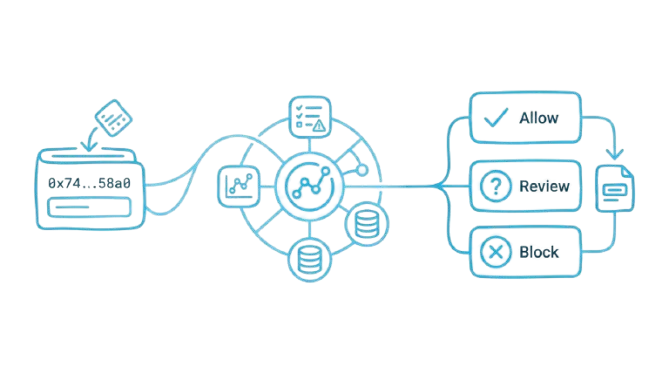
Submit a wallet
Send an EVM address and optional transaction context through a simple API request.
EVM wallet risk scoring
KairoRisk gives payment processors, wallets, on/off-ramp providers and fraud teams an explainable risk score before a transaction becomes an operational problem.
KairoRisk is designed to fit into checkout, withdrawal review, wallet onboarding and case-management flows without forcing a team to rebuild its fraud stack.
Send an EVM address and optional transaction context through a simple API request.
The model blends wallet behavior, graph context, known-risk intelligence and policy rules.
Return allow, review or block-style guidance with reason codes analysts can audit.
The sample below mirrors the operational output a crypto team can route into payout, ramp, onboarding or wallet-protection workflows.
KairoRisk is not a marketing dashboard. It is a decision layer for teams that need to screen a source or destination wallet, explain why it is risky and route the result into a real workflow.
Score payout or deposit wallets before money moves, then route edge cases to review.
Add a risk signal before onboarding, cashout or high-value crypto transfer flows.
Warn, review or hold risky wallet interactions before users sign or send.
Give analysts score, reason codes, graph context and policy output in one response.
Separate low-risk activity from wallets that deserve enhanced review.
Store customer outcomes for audited offline releases instead of unsafe online learning.
The API is built for product and risk teams that need a compact response: risk score, decision, reason text and evidence fields that can be logged with a customer case.
POST /v1/score/wallet
{
  "chain": "ethereum",
  "wallet": "0x8f3a...91c2",
  "policy": "review_first"
}

200 OK
{
  "risk_score": 84,
  "risk_level": "HIGH",
  "decision": "hold_or_review",
  "confidence": 0.91,
  "reason_codes": [
    "scam_graph_proximity",
    "transaction_anomaly",
    "registry_risk_signal"
  ],
  "risk_scoring_explanation": {
    "what": "Advisory wallet risk score",
    "why": "Wallet activity and graph context match high-risk review patterns"
  }
}
The product is intentionally positioned as advisory risk intelligence: auditable, explainable and safe to validate in shadow mode before production blocking.
Ethereum-family networks are the current product focus. New chains should be validated through shadow scoring and client-specific feedback before hard blocking.
Validation-grade ROC/AP evidence is presented as ranges to avoid overclaiming perfect live performance.
Decision bands are tuned per client appetite, with review-first rollout recommended for pilots.
Customer outcomes are stored for review and offline release work, not unsafe online learning.
Responses include score, decision, risk level and explanation fields for analyst workflows.
The recommended rollout is deliberately conservative: run shadow scoring, compare against existing customer outcomes, tune thresholds and only then move the safest action bands into production routing.
Batch score known clean, risky and reviewed wallets to establish baseline value.
Score live events without customer-facing blocking while decisions are logged.
Promote allow/review/block thresholds only after measured false-positive review.
KairoRisk is packaged for technical review: not just a score, but the validation discipline, policy layer, API behavior and monitoring path needed before a buyer routes real money through it.
Source-disjoint and temporal holdout checks, blind evaluation sets, hard-negative clean cohorts and leakage controls before a release is considered production-ready.
Weekly stability, source slices, missing-feature resilience, adversarial wallet patterns, drift simulation and out-of-domain review for safer real-world rollout.
Risk score, confidence, risk level, reason codes and allow/review/block-style bands are separated so a client can tune policy without retraining the model.
Smoke-tested API path, shadow logging, replay runs, health checks, audit-friendly outputs and rollback-oriented deployment notes for pilot integration.
API codebase, scoring runtime, model artifacts, blend configuration, evaluation reports, explainability logic, docs, one-pagers and buyer handoff materials.
No. KairoRisk is advisory wallet risk intelligence and decision support. It is not a legal determination of fraud and should be validated inside the buyer's own compliance process.
Yes, but through a quarantined workflow. Customer outcomes should be reviewed and audited before they are considered for future offline releases.
Share the intended workflow and timeline. The usual next step is a fit check, then a shadow pilot scope or due-diligence pack for serious requests.